
How Does an ASIC Miner Work?
No jargon, no moon-talk. What the “ASIC” in an ASIC miner actually means, what’s inside the box, and why one machine does a single job better than a whole room of computers ever could. Then the part most guides leave out.

built for one job. Nothing else. An ASIC miner is simpler than the name makes it sound. Here it is, plainly.
ASIC stands for Application-Specific Integrated Circuit. In plain words: a chip built to do exactly one thing, and nothing else.
Your laptop chip is a generalist. It runs your browser, your email, your music, all of it passably well. An ASIC gives every bit of that up. It can’t open a web page or play a video. It was etched at the factory to run one calculation, the one Bitcoin mining needs, and to run it billions of times a second. That single-mindedness is the whole trick: give a chip one job and let it forget everything else, and it does that job faster and cheaper than any all-rounder alive. The one job is hashing, guessing numbers, racing the rest of the network to seal the next block and earn fresh Bitcoin for it. If that part is new to you, start with what a Bitcoin miner is.
A generalist chip does everything. An ASIC does one thing, and outruns them all at it.
Mining didn’t start with ASICs. It ended with them.
In the early days people mined on laptop processors. Then on graphics cards, which guessed faster. Then on machines built for nothing but mining. Each jump chased the same prize: more guesses out of every watt of electricity. Whoever squeezed more work from the same power won, so the hardware kept getting narrower and more specialised until there was nothing general left in it. The ASIC is the end of that road. There’s no faster way to mine Bitcoin than a chip that does nothing but mine Bitcoin, which is also why you can’t meaningfully mine on the computer you already own: a laptop against a modern ASIC is a rowing boat against a container ship.
Every step of mining hardware chased one number: work per watt. The ASIC is where that chase stops.
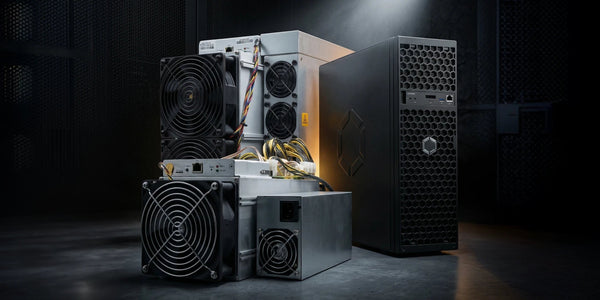
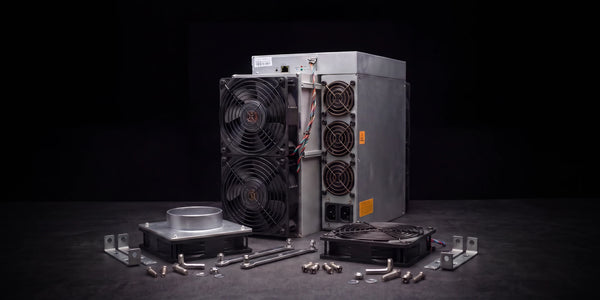
Open one up and there’s less mystery than you’d expect. A stack of chips, a power supply, and a lot of moving air.
The work happens on hashboards: flat boards packed with dozens of those single-job chips, several boards to a machine. A power supply feeds them, and fans drag a hard stream of air through the whole thing to keep it from cooking itself. That’s the machine. It plugs into the wall, connects to the internet, joins a mining pool so payouts come steady, and then it just runs, day and night, doing its one job without you touching it.
A stack of chips doing one sum, a wall of air keeping them alive. That is an ASIC miner.
Two numbers tell you how good any ASIC is, and they are the only two worth learning.
Hashrate, measured in terahashes per second (TH/s), is how many guesses it makes, so higher means better odds. Efficiency, measured in joules per terahash (J/TH), is how much electricity each of those guesses costs, so lower means cheaper to run. A strong modern miner is both at once: it guesses a lot and wastes little. Watts alone don’t tell you much, because two machines can pull the same power while one does far more work with it. That gap is efficiency, and it’s what separates today’s miner from a five-year-old one. You can run real machines through the profitability calculator to see it.
Hashrate is how fast it guesses. Efficiency is what each guess costs. Learn those two, ignore the spec-sheet noise.

Here’s what the numbers never mention: nearly all the electricity an ASIC draws leaves the box as heat. Waste it and mining is expensive. Use it and the maths flips.
A miner is a computer, and like any computer it runs warm, only this one runs warm on purpose, all day, at the scale of a space heater. Feed it a kilowatt and you get roughly a kilowatt of heat back out the other side. Most setups blow that straight out a window. Our Bitcoin heaters put it to work warming your room while the same electricity earns you Bitcoin, and they all run from our app, which handles the pool, payouts and settings for you, so setup is quick and effortless. One stream of electricity, two useful jobs: warmth now, Bitcoin you keep.
An ASIC was always going to make heat. The only question is whether you use it.
Run your miners the easy way with Port
Bought your first miner and don't fancy wrestling with pools and configs? Plug it into the Port and it handles the setup. The simplest way in, and it grows with you as you add more.
- Plug and play, running in minutes
- Up to 4 miners on one Port
- Automatic detection, real-time monitoring
- Control everything from one app


An ASIC Miner, at a glance
- An ASIC is a chip built to do one job: hash, billions of times a second
- It beat laptops and graphics cards by trading flexibility for pure work-per-watt
- Inside: hashboards of chips, a power supply, and fans moving a lot of heat
- Judge one on two numbers: hashrate for speed, efficiency for cost per guess
- Almost all its power comes back as heat, so use it twice instead of wasting it
Ready to start? Pick a miner


Found this useful?
Share it with someone weighing up their first miner.