
What Is a Bitcoin Miner?
No jargon, no moon-talk. What a miner actually is, what it does all day, and what it really takes to run one. Then the part most guides leave out.

Before miners click into place, one quick thing about Bitcoin itself.
Bitcoin is money with no bank in the middle. Normally a bank keeps the ledger, the running list of who owns what. Bitcoin hands that job to thousands of computers around the world instead, and they all keep the same shared record. Here is the shape of it: roughly every ten minutes, all the Bitcoin transactions from those ten minutes get bundled together into a block, and that block is locked onto the end of the one before it. Do that over and over and you get a chain of blocks, the blockchain. Everyone holds the same copy and has to agree on it, so no single company owns it and no one can quietly rewrite it, because changing an old block would mean out-computing the whole network at once. If you want it from the source, Satoshi Nakamoto laid the whole idea out in 2008 in a nine-page whitepaper.
Each block is about ten minutes of transactions, locked to the one before it. That chain of blocks is the blockchain, and adding the newest block is what mining does.
So who keeps that shared record? Computers called nodes. The ones that write the next page are the miners.
Every computer running Bitcoin is a node. It holds a full copy of the blockchain and checks that every transaction follows the rules. Miners are nodes with one extra job: they gather up recent transactions and compete to add them as the next block in the chain. That work is what keeps Bitcoin running, and it is the work you get paid for.
Every node holds the same chain and checks the others. Miners are the nodes that add to it.
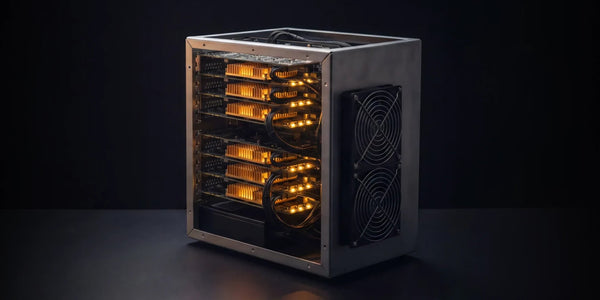
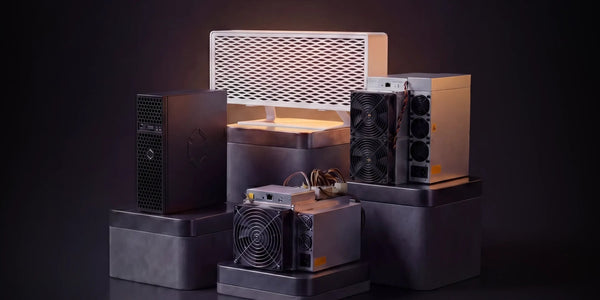
A Bitcoin miner is just a computer. One that does a single job, faster than any laptop could.
It isn’t digging anything out of the ground. It’s a stripped-down machine built around one kind of chip, an ASIC (application-specific integrated circuit). That chip does a single calculation and literally nothing else, which is exactly why it’s fast. Your laptop is a generalist: it can do a thousand jobs, each one so-so. A miner is a specialist: it does one sum millions of times a second and would be hopeless at anything else. That’s also why a gaming PC or a phone can’t meaningfully mine today, and why a machine the size of a shoebox out-computes all of them combined.
So what is that one calculation? Guessing. Just at a scale that’s hard to picture.
Every ten minutes a new block needs sealing, and miners race for the job. Think of it like a brute-force lock: the miner tries a number, checks if it opens the lock, and if it doesn’t, tries the next one. Billions of times a second. There is no shortcut and no working backwards, you just keep guessing until one fits. The first miner to land it seals the block and gets paid, everyone else checks the answer in an instant, and the race starts again. And because a winning number is so hard to find, simply having one proves the miner did the work. That is what "proof of work" means.
How many guesses a miner makes per second is its hashrate, trillions of tries every second.
Here’s the clever bit. However many miners join, and however fast the machines get, a block still lands about every ten minutes. By design.
If mining were a fixed puzzle, faster hardware would make blocks arrive quicker and quicker. Bitcoin doesn’t allow that. Every couple of weeks the network checks how fast blocks have been coming and adjusts the difficulty, how many leading zeros you need, up or down, to drag the average back to ten minutes. So when the world adds mining power, the bar just rises for everyone. Your odds of sealing a block don’t come from how fast your miner is on its own, but from your share of the total: your hashrate divided by the whole network’s.
Seal a block and you collect two things: brand-new Bitcoin, plus the fees from the transactions inside it.
The new-coin half is set by the network, and it steps down on a schedule. It started at 50 Bitcoin per block back in 2009. Every four years or so it halves, an event called the halving. Right now it’s 3.125. It keeps halving until around the year 2140, when the last coin is issued and miners earn from fees alone. That shrinking reward is Bitcoin’s built-in scarcity, and it is why efficiency matters more every cycle: fewer coins per block means the electricity behind each one has to get cheaper to keep up.
Bitcoin per block, halving roughly every four years. We are at 3.125 today. The next drop lands around 2028, and it keeps halving until the last new coin around 2140.
A miner’s only real input is electricity. That one fact decides everything.
More guesses means better odds, and every guess costs a sliver of power, so a working miner draws about as much as a space heater running around the clock. But watts aren’t the whole story. Two machines can pull the same power while one does far more hashes with it. That’s efficiency, measured in joules per terahash (J/TH), and it’s what separates a current miner from a five-year-old one. Put it together and your profit is a tug-of-war between four numbers: your electricity price, your machine’s efficiency, the network’s difficulty, and the price of Bitcoin. Difficulty and the Bitcoin price are out of your hands. The price you pay for power and the efficiency of your hardware are yours to choose. (You can run your own numbers through the profitability calculator.)
"Mining isn’t profitable" is true for almost everyone. Not because it’s a scam, because of that number.
The big farms don’t win on magic hardware. They win because they’ve hunted down the cheapest power on earth. A miner running on normal household rates can’t keep up, and that’s where "mining is dead" comes from. Flip that one number, get your power cheap or free, and the same machine that loses money for everyone else quietly starts working for you.
The thing that makes mining "dead" for most people is the exact thing you can solve.

Almost all the power a miner uses comes back out as heat. Waste it and mining is expensive. Use it and the maths flips.
A miner is a computer, and like any computer it runs warm. Nearly everything you feed it leaves as heat. Our Bitcoin heaters put that heat to work warming your room while the same electricity earns you Bitcoin. One stream of electricity, two useful jobs: warmth now, Bitcoin you keep.
Power in. Bitcoin and heat out. Nothing wasted.
Run your miners the easy way with Port
Bought your first miner and don't fancy wrestling with pools and configs? Plug it into the Port and it handles the setup. The simplest way in, and it grows with you as you add more.
- Plug and play, running in minutes
- Up to 4 miners on one Port
- Automatic detection, real-time monitoring
- Control everything from one app

A miner, at a glance
- A miner is a single-purpose computer that does one thing: hash
- It races the whole network to seal blocks and earn Bitcoin
- Your odds are just your share of the total hashrate
- Profit is a fight between power price, efficiency, difficulty and the Bitcoin price
- The two you control are cheap power and reusing the heat
Ready to start? Pick a miner


Found this useful?
Share it with someone weighing up their first miner.