
What Is Proof of Work? Bitcoin's Engine Explained
Proof of work is the idea that makes Bitcoin trustworthy without a bank. It sounds academic, but it is simple, and it is exactly what your miner is doing. Here is proof of work in plain English.

Proof of work is exactly what it sounds like
Proof of work is a way to prove you did real, costly effort, without anyone having to trust you. In Bitcoin, miners repeatedly guess numbers until one produces a valid answer to a hard puzzle. Finding that answer takes an enormous amount of computing, and therefore electricity, but checking it takes a fraction of a second. So a miner cannot fake having done the work, the proof is baked into the answer itself, and anyone in the world can verify it instantly.
Hard to produce, trivial to check. That asymmetry is the whole trick.
It replaces a bank with pure physics
Normally, trust comes from an authority: a bank confirms your balance, a government backs the money. Bitcoin has neither, and proof of work stands in their place. Because adding a block to the chain costs real electricity, changing the record after the fact would mean redoing all that work faster than the entire honest network combined, which is practically impossible. The cost of the work is what makes the history permanent and the network trustworthy, with no one in charge.
The energy is not the price of using Bitcoin. It is the reason Bitcoin can exist at all.
Louhija muuttaa yhtä lukua ja tiivistää lohkon uudelleen, miljardeja kertoja sekunnissa, kunnes tulos sattuu alkamaan riittävällä määrällä nollia. Oikotietä ei ole. Juuri se on työ proof of workissa.
The main alternative trades energy for stakes
You will hear about proof of stake, the system some other coins use, most famously Ethereum. Instead of spending electricity, validators lock up coins as collateral and are trusted in proportion to what they put at risk. It uses far less energy, which is its big selling point. But it also ties security to owning the coin rather than to a real-world cost outside the system. Bitcoin deliberately sticks with proof of work, because that external, physical cost is exactly what its supporters trust.
Less energy, different trade-off. Bitcoin chose the version anchored in the real world.
Your miner is a proof-of-work machine, nothing more
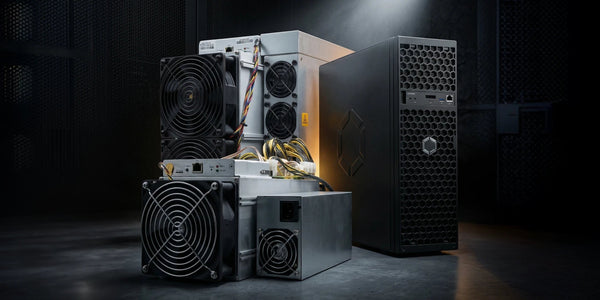
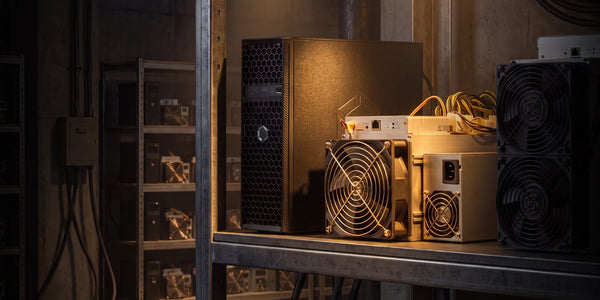
Everything an ASIC miner does is proof of work. It takes the current block, adds a guess, runs it through the SHA-256 function, and checks whether the result clears the target. If not, it changes the guess and tries again, trillions of times a second. There is no cleverness and no strategy, just relentless trial and error until it or someone else wins. When people say a miner is powerful, they mean it can make those guesses faster, which is measured in hashes per second.
A miner is not solving equations for science. It is doing proof of work, over and over, at enormous speed.
Rewriting history means outworking the entire network
This is where the cost pays off. To change a transaction from last week, you would have to redo the work on that block and every block built on top of it, and do it faster than every honest miner on earth is producing new ones. That means commanding more computing power than the rest of the network combined, and paying the electricity bill for it the whole time. The deeper a block is buried, the more absurd the sum becomes. Nobody is guarding the ledger. The arithmetic is.
The record holds because rewriting it costs more than anyone stands to gain.


The 30-second recap
- Proof of work means spending real computing effort to earn trust
- Solutions are expensive to find but trivial for anyone to check
- That cost replaces a bank and makes Bitcoin's history tamper-proof
- Proof of stake uses less energy but a different trust model; Bitcoin keeps proof of work
- A miner that heats your home turns that spent energy into warmth
Ready to buy? Pick your miner


Found this useful?
Share it with someone weighing up their first miner.