
What Is Crypto Mining? A Plain-English Guide
Crypto mining sounds technical, but the core idea is simple. Here is what mining actually does, why it uses so much electricity, and whether it is worth doing at home.

Mining means securing a blockchain, not making coins from thin air
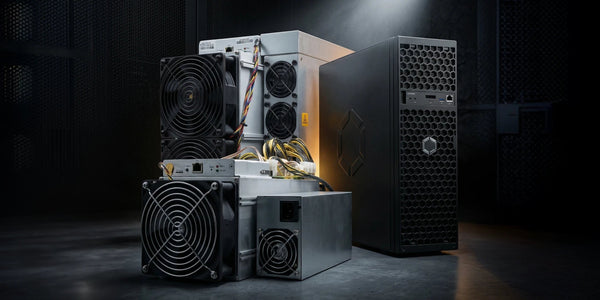
Crypto mining is the process that keeps a proof-of-work blockchain like Bitcoin running. Miners are specialised computers that bundle recent transactions into a block and then compete to solve a hard mathematical puzzle. The first to solve it gets to add the block and earns a reward in new coins plus transaction fees. The puzzle has no shortcut, so the only way to win more often is to do more computing, which is exactly why mining eats electricity.
So mining is not printing money. It is spending energy to keep a network honest, and getting paid for it.
The electricity is the whole point, not a bug
People often ask why mining has to burn so much power. The answer is that the energy is the security. Because adding a block costs real electricity, rewriting history or cheating the network would cost an attacker a fortune in power, and that cost is what makes Bitcoin so hard to tamper with. Other coins use different systems, some have moved to proof of stake which uses far less energy, but the big proof-of-work coins still rely on miners spending real electricity.
The power bill is not waste. It is the wall that protects the network.
Not every coin is mined the same way, or at all
Bitcoin is the original and by far the biggest mineable coin, and it is mined with purpose-built ASIC machines. Some other coins, like Litecoin or Dogecoin, are also mined, sometimes on similar hardware. Many newer coins are not mined at all, they use proof of stake instead. And plenty of coins you simply cannot mine profitably at home because big industrial operations dominate them. For most people at home, Bitcoin is the one that actually makes practical sense to mine.
If someone offers to mine an obscure coin for you cheaply, be careful. The honest game is mostly Bitcoin.
Bitcoin, and coins like Litecoin or Dogecoin on similar hardware.
Most newer coins use proof of stake instead of mining.
Coins where industrial operations leave nothing for a home machine.
For someone mining at home, Bitcoin is the one that makes practical sense.
Whether it pays comes down to one number
The maths of mining is brutally simple at heart. You earn coins, and you spend electricity. If the value of the coins you mine is higher than your power bill, you profit, and if it is not, you lose. Everything else, the price of the machine, the difficulty, the coin price, just feeds into that one comparison. For someone paying normal household electricity rates, mining alone usually loses. The people who win either have very cheap power, or they find a second use for the energy.
The winners are not the ones with the biggest machines. They are the ones with the cheapest, or double-used, electricity.

At home, the second use is heat
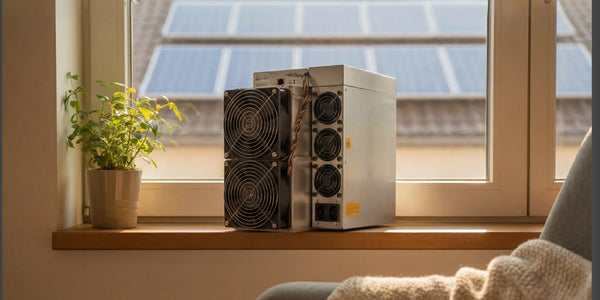
This is where mining stops being a money pit for normal people. A crypto miner turns almost all the electricity it draws into heat. If that heat just escapes, you have paid for it twice, once on the power bill and once when you still have to heat your home some other way. But a miner that also heats your home uses the same electricity for two jobs at once, warmth you needed anyway, plus the coins on top. Suddenly the power bill is not a loss, it is your heating bill doing double duty.
That is the only version of home mining that reliably makes sense, and it is exactly what we build.


The 30-second recap
- Crypto mining validates transactions and earns new coins for the work
- Proof of work spends real electricity on purpose, to keep the network secure
- Bitcoin is the main coin worth mining at home; many coins cannot be mined
- It only pays when the coins are worth more than the electricity
- A miner that also heats your home is the version that reliably works
Ready to buy? Pick your miner


Found this useful?
Share it with someone weighing up their first miner.